
SKU Rationalization
Replace competitive SKUs with your better-performing ones by showing the merchant that you perform better than a competitive like-for-like SKU. Alternatively, replace your bottom-performing SKUs with items that have a stronger market position to drive category velocity.
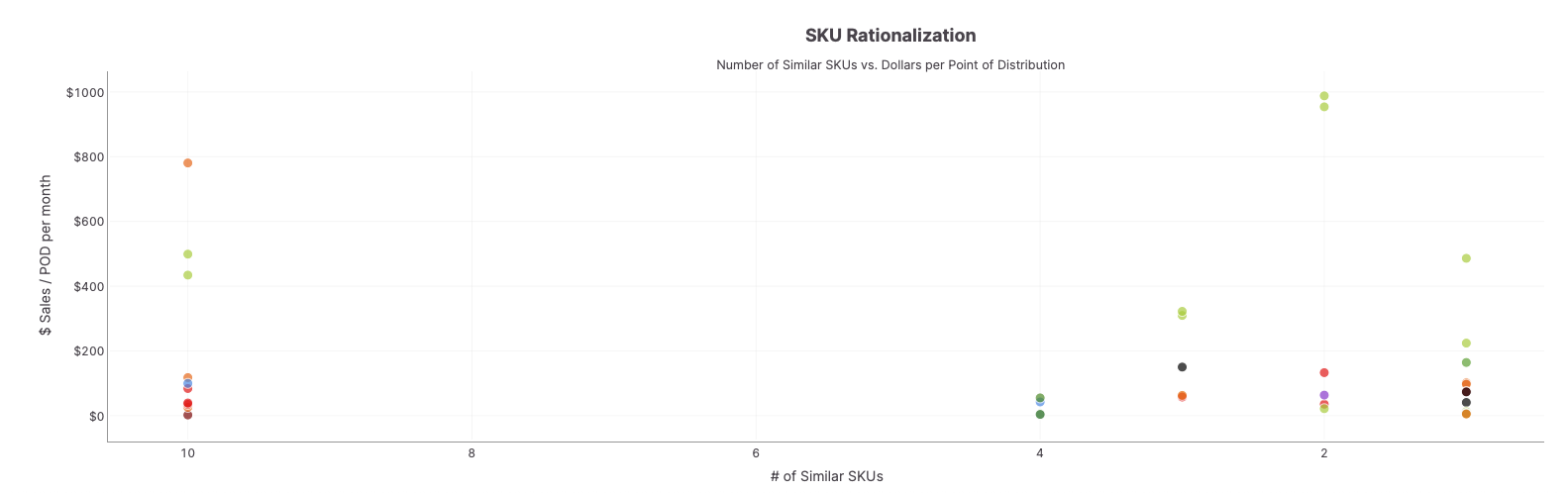
SKU Rationalization Basics
How to Read
Each dot on the chart represents an item in your category, color coded by Brand. Items on the left hand side of the chart have the highest number of competitive items in your category and the higher the item is on the y-axis, the better that item performs on a per store basis.
How to Use
Look for items with the most competitors (left-hand side of the chart) that perform best on a per-store basis to identify opportunities for a retailer to optimize their assortment through SKU replacements and maximize the category's sales velocity. Look for productive SKUs that have the strongest market position (upper left hand side of the chart) and the least productive and most commoditised SKUs (bottom of the chart). Find opportunities to drop or replace poor performers, simplify a retailer's assortment and maximize the category's sales velocity. Drill down into specific attribute combinations and price buckets to isolate similar products and find opportunities to replace poor-performing SKUs with your more productive items.
Key Metrics
$ Sales per Point of Distribution per Month (Y-axis)
Allowing for comparisons across SKUs while controlling for distribution and amount of time they were on the market.
Methodology: $ Sales / Monthly Avg. Number of Stores with Inventory
Number of Similar SKUs (X-axis)
The x-axis shows the number of SKUs of competitive items present in the market for each SKU, determined by your attribute selection and price buckets.
Case Studies
Recommended Next Steps
Assortment Summary
Assess the health of your assortment relative to your competitors and get a detailed breakdown of the items driving performance.
Attribute Trends
Use product attributes to identify assortment gaps and drive product development or argue for shelf placement in your next PLR.
SKU Comparison
Create custom groupings of SKUs and easily compare your product to your competitors across competitive benchmarks.